


A recent warning attributed to the FBI highlights a growing pattern of cyber-enabled cargo theft across North America, where attackers are increasingly blending digital intrusion with traditional logistics fraud. The activity reportedly targets shippers, freight brokers, and carriers, with losses said to be mounting as criminals refine their methods and focus on high-value goods.
Cyber-Enabled Cargo Theft
According to the alert, there has been a notable increase in cargo theft operations involving cyber tactics since 2024, with reported losses approaching hundreds of millions of dollars in 2025. The activity is described as more targeted than in previous years, with groups selecting shipments that are both valuable and difficult to trace once stolen. Electronics, consumer goods, and industrial materials are among the commonly cited targets. The scale and coordination of these operations appear to benefit from the complexity of modern supply chains, where multiple intermediaries and digital systems create opportunities for exploitation.
Impersonation and System Compromise
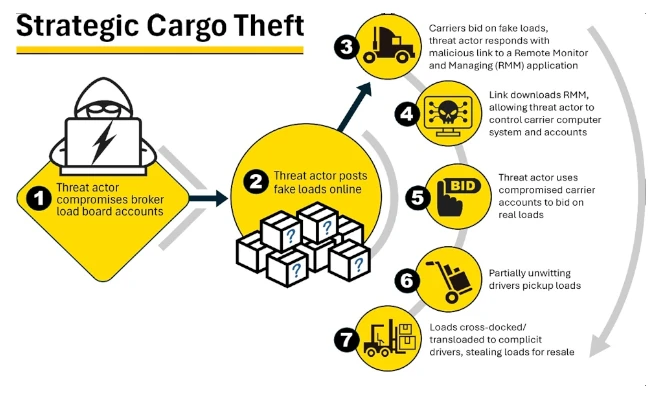
A central element of these schemes involves impersonation. Attackers reportedly pose as legitimate businesses within the logistics chain, using spoofed email addresses, cloned domains, or compromised accounts to establish credibility. In some cases, phishing emails are used to deliver malware, allowing unauthorized access to internal systems. Once access is gained, attackers are said to monitor shipment data and identify suitable targets. They then use the stolen or replicated identities to communicate with brokers and shippers, presenting themselves as authorized carriers.
Load Boards and Double-Brokering Tactics
Another method described involves fraudulent activity on load boards, which are commonly used to match freight with carriers. Attackers allegedly post fake listings or respond to legitimate ones, offering transport services they do not intend to fulfill. A related tactic, often referred to as double-brokering, involves rerouting shipments without the shipper’s knowledge. In these scenarios, legitimate carriers may unknowingly transport goods under false instructions, with delivery locations altered by the attacker. By the time discrepancies are noticed, the cargo may already be diverted.
Red Flags and Operational Weak Points
The warning points to several indicators that may signal fraudulent activity. These include subtle alterations in email domains, unusual formatting in contact information, and the use of free email services. Phone numbers associated with mobile apps or international origins are also mentioned as potential warning signs. Phishing messages may reference negative reviews or urgent issues, encouraging recipients to click on links or provide credentials. The success of these approaches is attributed in part to gaps in verification practices and the reliance on email-based communication for logistics coordination.
Conclusion
The reported increase in cyber-assisted cargo theft reflects a shift toward more hybrid forms of fraud, where digital access and real-world logistics intersect. The methods outlined suggest a focus on infiltration rather than brute force, with attackers leveraging trust, routine processes, and fragmented systems to carry out operations. While the warning frames these developments as a growing concern, it ultimately presents a snapshot of how supply chain vulnerabilities are being actively explored and exploited.





























No comments yet — be the first.
Join the conversation
Log in to leave a comment