

Anubis is a relatively new darknet marketplace, having launched just under a year ago. Since its debut, the market has grown steadily, now hosting around 3,000 active listings. Approximately half of these listings are digital or counterfeit items, with the rest covering a wide range of illicit goods. The marketplace offers everything one would expect from a darknet market, including drugs, prescription medications, counterfeit products, and various digital goods such as hacking tools, software, and stolen data.
Design and Usability
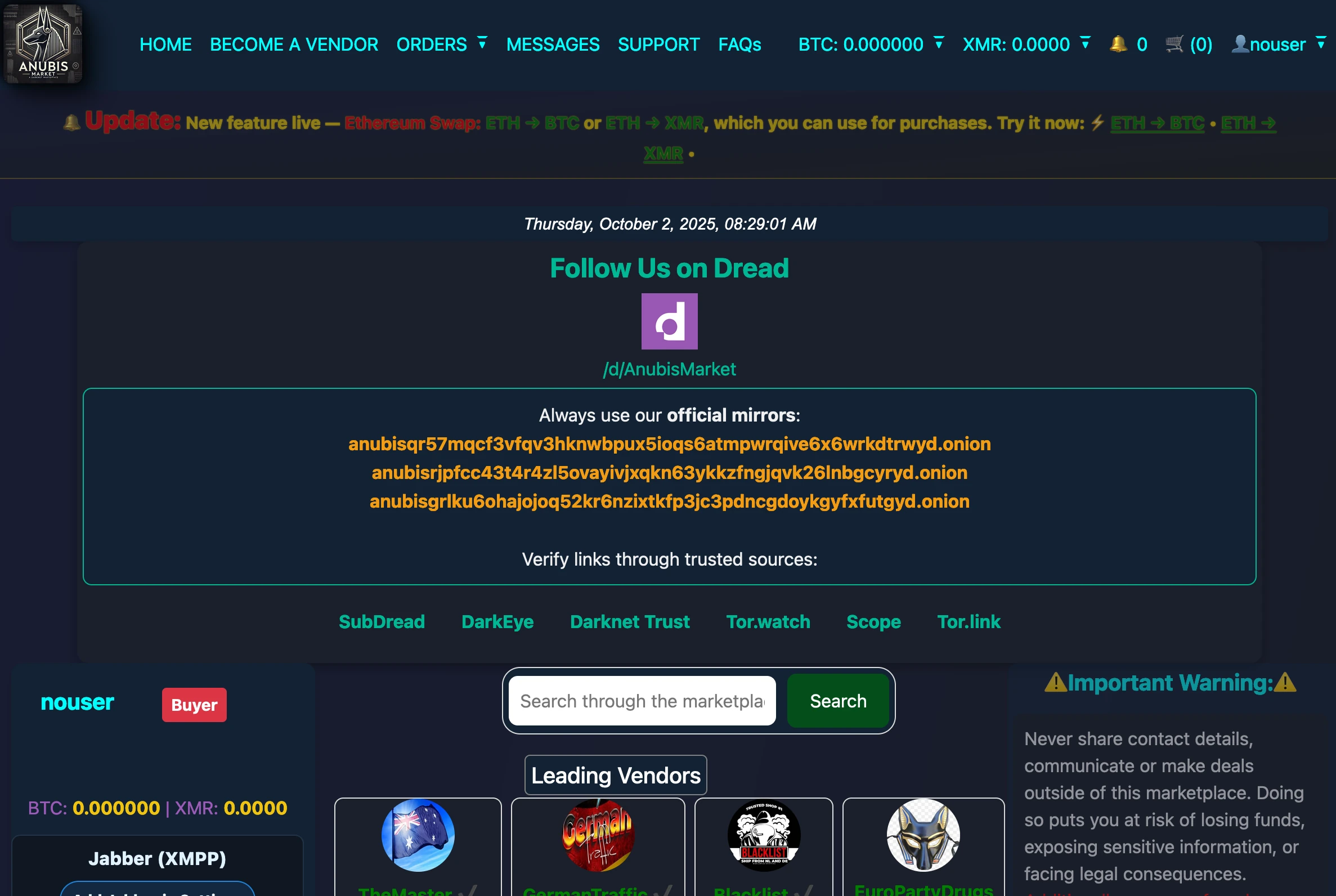
In terms of design, Anubis has significant room for improvement. The marketplace appears cluttered, inconsistent, and somewhat outdated, resembling what one might stereotypically expect of darknet market platforms. Despite its aesthetic shortcomings, the interface is well structured and intuitive to use. Categories are neatly organized, making navigation straightforward, and a basic search function is available to help users find products quickly.
Payment Options and Purchases
Anubis supports payments through both Monero (XMR) and Bitcoin (BTC). Monero is generally regarded as more secure due to its privacy features, while Bitcoin remains a more traceable option. Funds can be deposited into a built-in wallet linked directly to the user’s account, or payments can be made directly at the point of placing an order. All transactions are protected through traditional escrow systems, and trusted vendors have the option to use Early Finalization (FE) for faster delivery. Anubis also features a built-in cart system, allowing multiple items to be purchased in a single transaction for convenience.
Additional Features
Beyond the basic marketplace functionalities, Anubis offers several additional tools. Jabber support allows users to receive notifications directly from the market, enhancing communication efficiency. The platform also includes a built-in exchange, enabling users to swap Ethereum for other cryptocurrencies such as Bitcoin or Monero. These features add flexibility and convenience for users looking to manage their transactions entirely within the platform.
Security Features
Anubis follows standard security protocols common among darknet marketplaces but introduces some unique elements as well as certain concerns. PGP support is available for both two-factor authentication (2FA) and message encryption, ensuring that users can secure their communications. Upon registration, users receive a mnemonic set of words that can be used to recover an account in emergencies, such as the loss of 2FA credentials. Additionally, a withdrawal pin is established before registration, providing an extra layer of security when funds are withdrawn.
However, the market’s approach to message encryption raises concerns. Messages are auto-encrypted using the recipient’s public key, which is not as secure as client-side encryption processed locally. This creates a risk that the servers could store logs or retain copies of unencrypted messages. Another point of caution is the use of Bitcoin, which, while common, remains one of the more traceable cryptocurrencies — a consideration for users seeking maximum privacy.
Conclusion
Anubis is an emerging darknet marketplace that continues to grow steadily, offering a broad selection of physical and digital illicit goods. While its design and security have room for improvement, these are easily addressable issues. So far the market seem to be growing at a relatively slow but good pace, and has a growing userbase of happy users. Continued refinement could make it a more polished, secure, and competitive marketplace in the darknet ecosystem.
















0 Comments