

Incognito Market, launched in late 2020, quickly gained popularity within the dark web community. Known for its anonymity and robust infrastructure, it became a prominent marketplace that hosted over 1,300 vendors at its peak. It offered a range of illicit goods and services, from narcotics to counterfeit documents, attracting a wide array of buyers and sellers. However, what initially seemed like a thriving marketplace would soon become the site of one of the most controversial exit scams in dark web history, followed by the arrest of its operator, revealing the complex dynamics at play.
The Exit Scam: A Calculated Betrayal
Incognito Market's downfall began with users reporting issues withdrawing their funds. At first, these complaints were dismissed as simple technical problems, but the frequency of these reports began to grow. Suspicion spread quickly within the community: was this just a glitch, or was something more deliberate taking place?
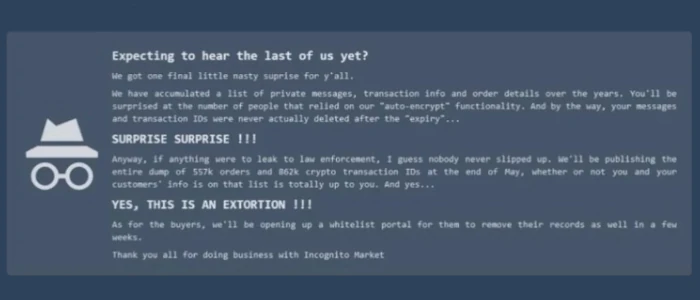
The situation took a darker turn when users attempting to access their accounts were met with a threatening message: "All your information will be leaked to law enforcement unless you pay. Once paid, it will be deleted." This message, coming from the marketplace’s operator, revealed that what was unfolding was not just a technical failure, but a full-blown exit scam. Pharaoh, the operator behind the market, was not simply shutting down the platform—he was demanding payment from users to prevent the release of their personal and transaction data.
The Extortion Scheme: A Sliding Scale of Threats
Pharaoh’s extortion scheme was structured around a sliding scale, where ransom amounts varied depending on the user’s activity level. For less active users, the ransom might be in the hundreds of dollars. However, for vendors who had made thousands of transactions, the amounts could reach tens of thousands. This created an uneven playing field, with many forced to choose between paying the ransom or facing the potential exposure of their personal information and criminal activities.
While some users had taken precautions, such as using end-to-end encryption and privacy coins, the threat of exposure was real for others who had less secure practices or were unfamiliar with how to protect themselves in such a situation. Despite this, some users chose to comply with the demands, paying up to protect their identities and avoid potential legal consequences.

Community Outrage: The Call for Revenge
The dark web community’s reaction to Incognito Market’s exit scam was swift and filled with anger. For many users, this was not just about the financial loss, but about a deep sense of betrayal. Pharaoh, who had built a reputation as the operator of one of the most popular markets, had taken advantage of his own community in an unprecedented way.
A wave of vengeance began to ripple through dark web forums and chat rooms, with individuals vowing to expose Pharaoh and bring him to justice in their own ways. In the complex, anonymous world of the dark web, where trust is often as valuable as currency, this betrayal was seen as unforgivable. However, the irony of the situation lay in the fact that the same community members who now sought justice were often involved in similarly illicit activities, operating in a world where anonymity and deception were commonplace.
The Arrest of Rui-Siang Lin: From Pharaoh to Fugitive
On May 18, 2024, the operator of Incognito Market, later identified as Rui-Siang Lin, was arrested at John F. Kennedy International Airport in New York. Lin, a 23-year-old Taiwanese national, had been the subject of an extensive investigation led by Homeland Security Investigations (HSI), in coordination with multiple law enforcement agencies. His arrest brought to light the scale of his operation, revealing that Incognito Market was responsible for millions of dollars’ worth of illicit transactions, including the sale of narcotics, counterfeit goods, and more.
The authorities’ investigation into Lin’s activities utilized a variety of tracking methods, including cryptocurrency tracing and data analysis, to build a case against him. According to reports, Lin's involvement went beyond merely running the marketplace—he was allegedly deeply involved in money laundering activities, enabling vendors and buyers to conduct transactions under a veil of anonymity. His arrest was a significant event in the ongoing efforts by various law enforcement agencies to disrupt the dark web’s criminal infrastructure.
However, the investigation into Lin’s activities has also sparked debates about privacy, data security, and the role of law enforcement in the dark web space. For many, the way the authorities handled the case is a reminder of the complex and often murky nature of the relationship between the dark web and the law. While the arrest may be seen as a victory for some, it also raised questions about privacy rights and whether these tactics will be used to target other individuals in similar situations.
Legal Proceedings and the Consequences
Following his arrest, Lin faced several serious charges, including narcotics conspiracy, money laundering, and conspiracy to distribute adulterated and misbranded drugs. These charges carried the potential for lengthy prison sentences, including the possibility of life imprisonment. In December 2024, Lin pled guilty to narcotics conspiracy and money laundering in a U.S. District Court.
Lin’s sentencing is scheduled for March 2025, and given the gravity of the charges, many speculate that he will receive a significant prison sentence. The case has brought the complexities of dark web marketplaces into the public eye, shedding light on the operations that underpin these illegal markets and the steps law enforcement is willing to take to dismantle them.
The Fragility of Dark Web Markets
The story of Incognito Market serves as a stark reminder of the fragility of the dark web marketplace ecosystem. From the initial rise of the platform, driven by a combination of demand and the promise of anonymity, to its sudden collapse in a cloud of extortion and betrayal, it highlights the inherent instability of these illicit platforms. Whether operated by individuals seeking profit or others with more nefarious intentions, these markets can collapse at any moment due to the unpredictable nature of the dark web, law enforcement interventions, or the very trust they rely on to function.
The arrest of Rui-Siang Lin, while marking the end of one criminal operation, also raises further questions about the broader landscape of dark web marketplaces. In a world where anonymity is both a shield and a weapon, users and operators alike are left to navigate a constantly shifting environment filled with both opportunities and dangers.

















0 Comments