
In March 2024, the global darknet community witnessed the shutdown of Nemesis Market, a notorious illegal marketplace that had grown to be one of the most well-known platforms on the dark web. Founded by Iranian national Behrouz Parsarad, who operated under the alias "Francis," the marketplace offered a wide range of illicit products and services, including illegal drugs, counterfeit identification documents, stolen financial data, and cybercrime tools. This article delves into the rise and fall of Nemesis Market, its illicit activities, and the significant law enforcement operation that ultimately dismantled the network.
The Rise of Nemesis Market
Launched in March 2021, Nemesis Market initially struggled to capture attention within the crowded darknet economy. In its early stages, the platform was relatively simple, lacking many key features that users had come to expect from top-tier dark web marketplaces. The design was basic, and crucial security features, were not yet implemented. However, the marketplace’s development team vowed to make significant improvements over time and this proved true, resultind in a rapid rise of popularity. By 2024, Nemesis had undergone a remarkable transformation, evolving into a fully featured darknet platform with a modern design and easy-to-use interface.
Unlike many other darknet markets, Nemesis integrated a forum alongside its marketplace, offering a space for users to discuss a range of topics, including criminal activities. The site’s user-friendly navigation and appealing aesthetics helped it become one of the most popular platforms on the dark web. As a result, Nemesis rapidly expanded, with over 150,000 users and 1,100 vendor accounts at its peak.
Nemesis Market’s Illegal Operations
At its core, Nemesis Market facilitated the sale of a vast array of illegal products. The platform became a go-to destination for those seeking illegal drugs, such as fentanyl, methamphetamine, heroin, and crack cocaine. Between 2021 and 2024, the marketplace processed over 400,000 orders.
Nemesis Market had a diverse, global user base, with significant activity in North America and Europe. Around 20% of the marketplace's sellers were based in Germany, reflecting the global nature of the darknet economy. Despite its international reach, the marketplace was able to operate relatively undetected for a time, leveraging the inherent anonymity of the dark web and the decentralized nature of cryptocurrency transactions.
Law Enforcement Response and Market Shutdown
The downfall of Nemesis Market began with an investigation initiated in October 2022. The case quickly gained international attention as U.S. law enforcement agencies, including the FBI, DEA, and IRS-CI, joined forces with German authorities (BKA) and Lithuanian police. The coordinated effort aimed to target and disrupt darknet crime, especially markets like Nemesis that were fueling the global drug crisis and supporting cybercriminal enterprises.
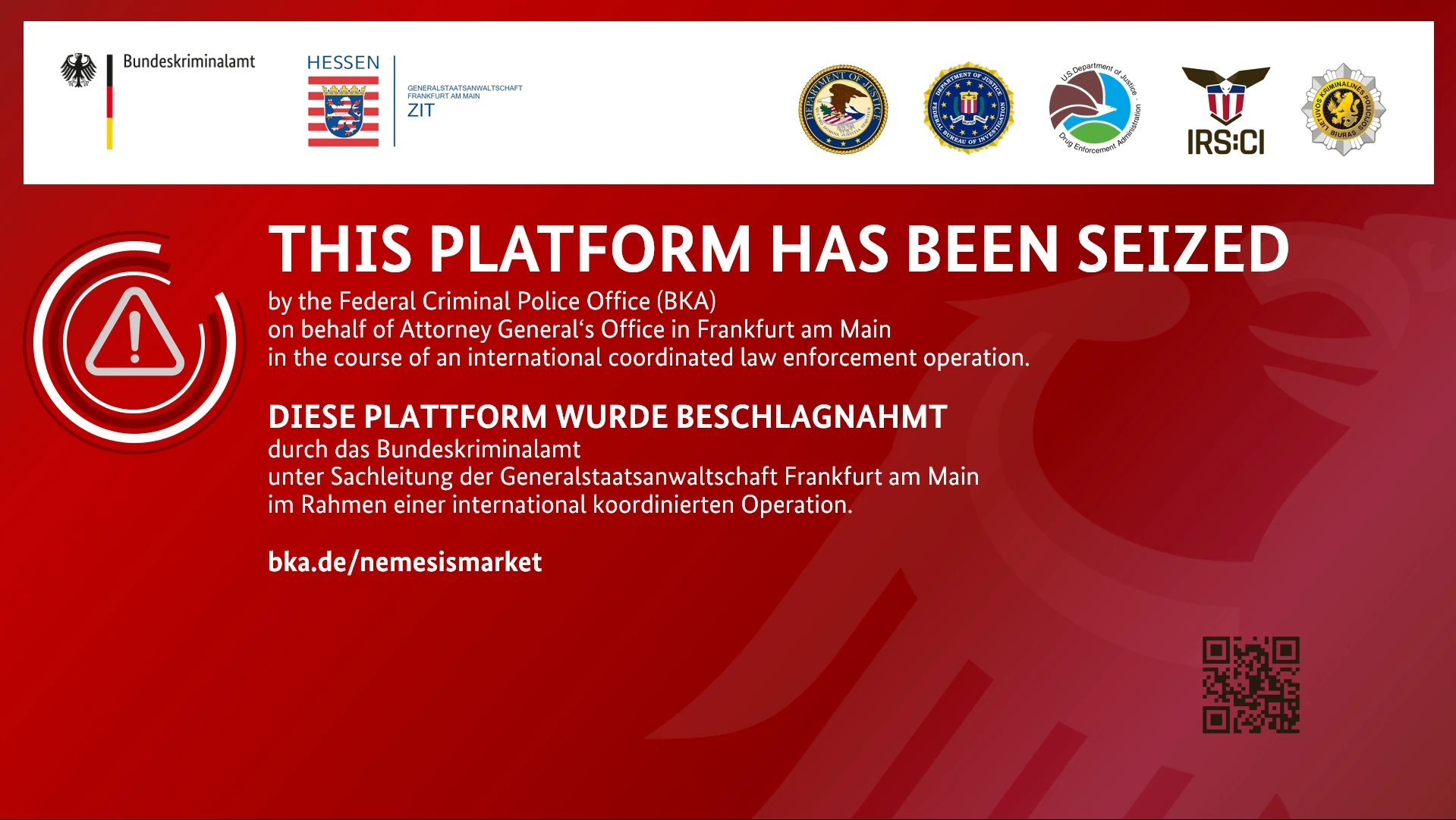
On March 20, 2024, after months of investigation and surveillance, law enforcement agencies successfully seized Nemesis Market’s infrastructure. German and Lithuanian authorities took control of the marketplace's servers, effectively shutting down the site. The market's website was replaced with a banner notifying users of the seizure and the loss of their data to law enforcement.
During the operation, authorities also seized cryptocurrency worth approximately 94,000 Euros, adding a financial blow to the criminal network. The seizure of Nemesis Market's data provided investigators with valuable insight into the operations of the marketplace, including detailed records of transactions, vendor information, and user data. This trove of information will likely aid law enforcement in identifying and arresting individuals involved in illicit activities on the platform.
The Indictment of Behrouz Parsarad
At the center of Nemesis Market’s operations was its founder and operator, Behrouz Parsarad, a 36-year-old Iranian national. Known by his alias "Francis" on the platform, Parsarad faces a series of charges following a recent indictment in May 2025. He is accused of conspiracy to distribute controlled substances, money laundering, and facilitating cybercrime. Parsarad allegedly used the proceeds from the sale of illegal drugs to fund further criminal activities and provided money laundering services via cryptocurrency mixing, which helped conceal the illicit origins of the funds.
The indictment claims that Nemesis Market operated from 2021 to 2022 and processed nearly $30 million in illegal transactions. It's also claimed that Parsarad's role in this vast operation led to the recent indictment. If convicted, Parsarad faces severe penalties, including a mandatory minimum sentence of 10 years in federal prison and a maximum sentence of life in prison.
While no arrest has been made as of the indictment, the U.S. Department of the Treasury's Office of Foreign Assets Control (OFAC) imposed sanctions on Parsarad in March 2025 for his role in operating the marketplace. The indictment highlights the significant international impact of his activities, including the wide-reaching consequences for those involved in darknet markets.
Ongoing Investigations and Future Implications
Despite the shutdown of Nemesis Market, law enforcement efforts seem to continue. The seizure of the platform’s data has provided investigators with crucial leads that could help them dismantle network of vendors and buyers involved in the market. As authorities work to track down individuals involved in illicit transactions, there is also a broader effort underway to target and disrupt other darknet marketplaces that facilitate illegal activities.
The takedown of Nemesis Market is a part of a larger, ongoing battle against between law enforcement and the darknet economy, which continues to fuel the global drug epidemic and support a range of cybercrimes. Law enforcement agencies from the U.S., Germany, Lithuania, and other countries are working together to address these challenges. Specialized task forces, such as the FBI-led Joint Criminal Opioid and Darknet Enforcement (J-CODE), are at the forefront of these efforts, targeting opioid trafficking and other criminal activities associated with darknet markets.
Conclusion
The shutdown of Nemesis Market served as a significant reminder of the ongoing battle between the darknet economy and and law enforcement. Through coordinated international law enforcement efforts, the marketplace was successfully seized, and its founder, Behrouz Parsarad, faces potential serious legal consequences for his role in the operation. As investigators continue to sift through the data obtained from the marketplace’s servers, it's a clear reminder that such operations can have consequences on people even years down the line.






0 Comments