


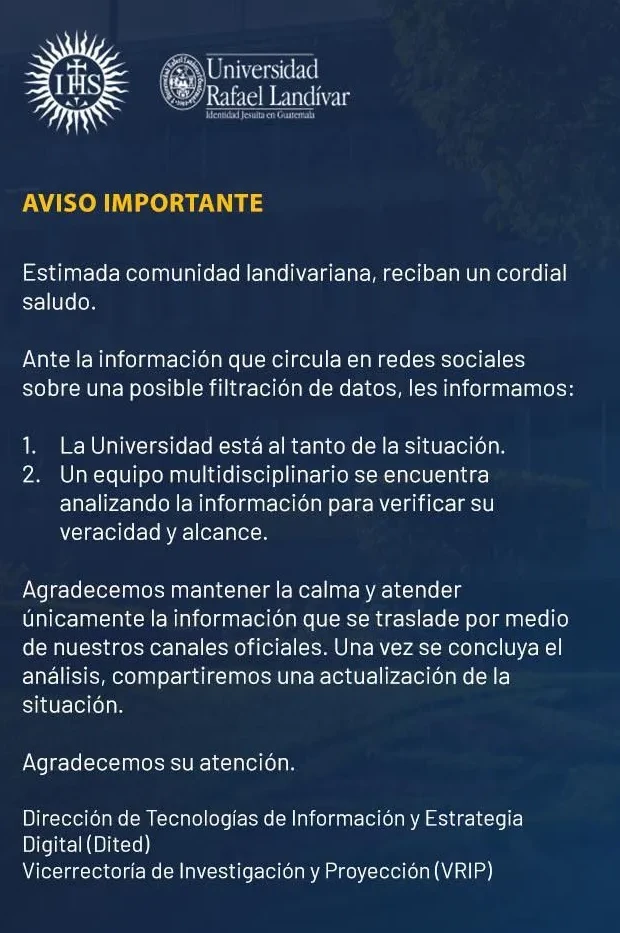
A suspected cyberattack targeting major academic institutions in Guatemala has triggered investigations and raised concerns about data security across the higher education system. The Universidad Rafael Landívar confirmed it is analyzing reports of a potential data leak, while separate findings suggest the breach may be part of a broader pattern affecting multiple institutions, including the Universidad de San Carlos de Guatemala. The scale and nature of the exposed information point to one of the most significant incidents of its kind in the country.
Institutional Response and Ongoing Verification
The Universidad Rafael Landívar stated that a multidisciplinary team is reviewing circulating claims about leaked data to determine their accuracy and scope. The institution has advised its community to rely only on official communication channels while the situation is assessed. Early reports linked the incident to a broader cyberattack that may have also compromised financial and administrative data from other universities.
Scope of the Leak
Independent analyses describe a large dataset allegedly extracted from the Landívar system, totaling approximately 20 GB. Within this dataset are tens of thousands of photographs tied directly to personal and academic records. A structured database file reportedly links these images with full names, dates of birth, and university identification numbers.
The exposure of around 84,620 individual records significantly increases the risk of identity misuse. The combination of biometric data, such as photographs with identifiable personal details creates a dataset that can be easily cross-referenced, amplifying its potential value in illicit contexts.
Attribution and Repeated Targeting
The breach has been attributed in reports to a threat actor known as MrGoblinciano. This same actor has previously been associated with a separate intrusion involving the Universidad de San Carlos, where financial records and internal documents were reportedly exposed. The recurrence of attacks linked to the same entity suggests a sustained focus on academic infrastructure in Guatemala. Observers note that the ability to access and extract large volumes of institutional data indicates potential weaknesses in system defenses or monitoring capabilities.
Risks Linked to Biometric Exposure
Unlike typical data leaks that involve passwords or emails, this incident includes biometric elements and official identification materials. University-issued photographs and ID numbers are often used for access control, verification, and administrative processes. Their exposure introduces the possibility of impersonation in both digital and physical contexts.The structured nature of the leaked data—where images are directly tied to identity fields, further increases the likelihood of misuse. This type of dataset can be repurposed for fraud schemes, account takeovers, or unauthorized access attempts within and beyond academic systems.
Recommendations and Immediate Measures
Technical assessments referenced in the reports recommend immediate precautionary steps for affected individuals. These include updating institutional credentials and reviewing account security. Additional measures under consideration involve reissuing identification cards and implementing stronger authentication mechanisms, such as multi-factor authentication, across university platforms. While these recommendations aim to reduce immediate exposure, they also reflect broader concerns about the preparedness of institutions to handle large-scale data incidents.
A Broader Pattern of Attacks
The university breaches appear within a wider context of cyber incidents affecting multiple government and public sector entities in Guatemala. Institutions such as the Ministry of Labor, the Dirección General de Control de Armas y Municiones, and the Ministry of Health have also been referenced in relation to recent attacks. Statements from President Bernardo Arévalo referenced the existence of an ongoing response involving protective measures and technical reviews. These remarks, however, remain part of official positioning and do not independently confirm the effectiveness or scope of mitigation efforts.
Conclusion
The reported breach involving the Universidad Rafael Landívar highlights a significant escalation in the scale and sensitivity of data exposures within Guatemala’s academic sector. The combination of biometric information and personal identifiers marks a shift toward more consequential leaks, with implications that extend beyond institutional boundaries. As investigations continue and institutions attempt to contain the fallout, the incident underscores persistent vulnerabilities in digital infrastructure. Whether this event represents an isolated breach or part of a sustained campaign remains unclear, but its impact on trust and data security within the academic environment is already evident.

























No comments yet — be the first.
Join the conversation
Log in to leave a comment