


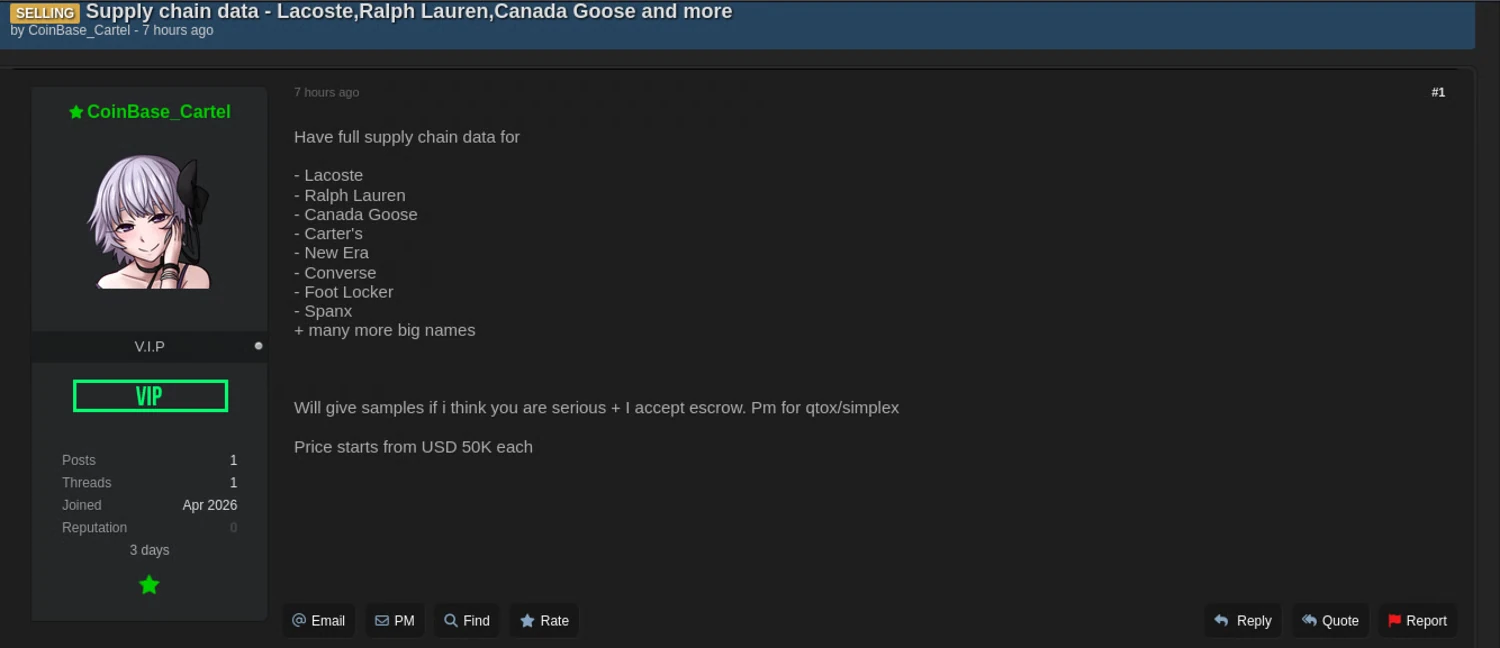
Several globally recognized retail brands are now being discussed on underground forums after a threat actor claimed to possess internal and customer-related data tied to multiple companies. Among those named are Lacoste, Ralph Lauren, Canada Goose, and Carter’s. Early samples have surfaced, but the full scope of the situation remains unclear, with no confirmed statements at the time of writing.
Information Samples
The individual behind the claims shared a limited number of screenshots for each brand, reportedly as proof of access. Analysis of these samples indicates the presence of employee-related information, including full names and corporate email addresses. Some files also appear to reference customer data, such as email and home addresses, although parts of that information were partially obscured before being posted. In addition to personal data, the material includes internal metadata—primarily numerical values and system-related identifiers. On its own, this type of data does not directly expose sensitive details but could become more meaningful when combined with other datasets.
Potential Risks
If the claims reflect legitimate access, both employees and customers could face increased risk of targeted phishing attempts. With identifiable details in circulation, attackers may attempt to impersonate staff or trusted brand communications to extract further information or gain access to internal systems. Such scenarios could lead to broader compromises, particularly if attackers are able to leverage trust-based interactions. However, the actual impact depends heavily on the scale and authenticity of the data, which has not yet been independently confirmed in full.
Supply Chain Entry Point
One notable detail is the similarity in data structure across all four brands. The consistency suggests the information may not have originated from individual breaches of each company, but rather from a shared third-party provider. The threat actor described the material as “supply chain data,” and technical indicators within the samples support that possibility. Researchers observed patterns consistent with SQL server database systems, including specific metadata such as row version identifiers. This points toward a scenario where a single compromised vendor—potentially involved in data management or logistics—could have served as the access point for multiple organizations.
Methods of Compromise
While no definitive cause has been established, several possibilities have been raised. Compromised employee credentials within a third-party provider could have enabled unauthorized access. Alternatively, system misconfigurations may have exposed internal data without requiring direct account breaches. Both scenarios are common in supply chain incidents, where the security posture of a single vendor can impact multiple downstream clients.
Retailers to Attract Attention
The broader retail industry has increasingly become a target for organized cyber activity. Over the past year, multiple brands across different market segments have been linked to large-scale data incidents. Previous cases have involved significant volumes of internal files, customer records, and operational data being leaked after alleged intrusions. These incidents highlight the ongoing interest in retail infrastructure, particularly where large datasets and interconnected supply chains are involved.
Conclusion
The situation involving Lacoste, Ralph Lauren, Canada Goose, and Carter’s remains unverified in full, but the available samples suggest at least some level of data exposure. The consistency across brands points toward a shared vulnerability, likely within a third-party provider rather than isolated breaches. Until official confirmations or denials emerge, the claims remain part of a broader pattern of retail-focused cyber activity, where supply chain weaknesses continue to present a viable entry point for attackers.





















No comments yet — be the first.
Join the conversation
Log in to leave a comment