


A new Windows Defender exploit has surfaced just hours after Microsoft patched a previously disclosed vulnerability, raising concerns about the ongoing tension between independent researchers and major vendors. The same individual behind the earlier release has now published another proof-of-concept, continuing a pattern of public disclosures that appear driven by personal grievances as much as technical findings.
A Follow-Up to a Recent Patch
The newly released exploit follows closely behind Microsoft’s fix for a privilege escalation flaw identified as CVE-2026-33825. That earlier issue allowed attackers to gain elevated system privileges, and it was addressed during the company’s latest Patch Tuesday rollout. Despite the patch, the researcher—operating under the alias “Nightmare-Eclipse”—has introduced a second method that allegedly achieves a similar outcome through different means. According to available details, the new exploit, referred to as “RedSun,” again targets Windows Defender. If functional, it enables unprivileged users to escalate access to SYSTEM level, effectively granting full control over a compromised machine.
Exploit Mechanism and Behavior
The core of the technique reportedly relies on how Windows Defender handles certain flagged files. The researcher claims that when the antivirus detects a malicious file associated with a cloud-based tag, it may rewrite that file back to its original location instead of removing it. This behavior can be manipulated to overwrite protected system files, opening a path to privilege escalation.
The proof-of-concept demonstrates this process in action, with the exploit not only elevating privileges but also executing additional actions once access is obtained. While the exact reliability and scope remain unclear, the method highlights potential weaknesses in how Defender manages remediation workflows.
Escalating Frustration and Threats
Alongside the technical release, the researcher published statements expressing ongoing frustration with Microsoft, particularly regarding prior interactions with its security response processes. They claim to have had a previous relationship with the company that deteriorated, leading to what they describe as personal and professional consequences.
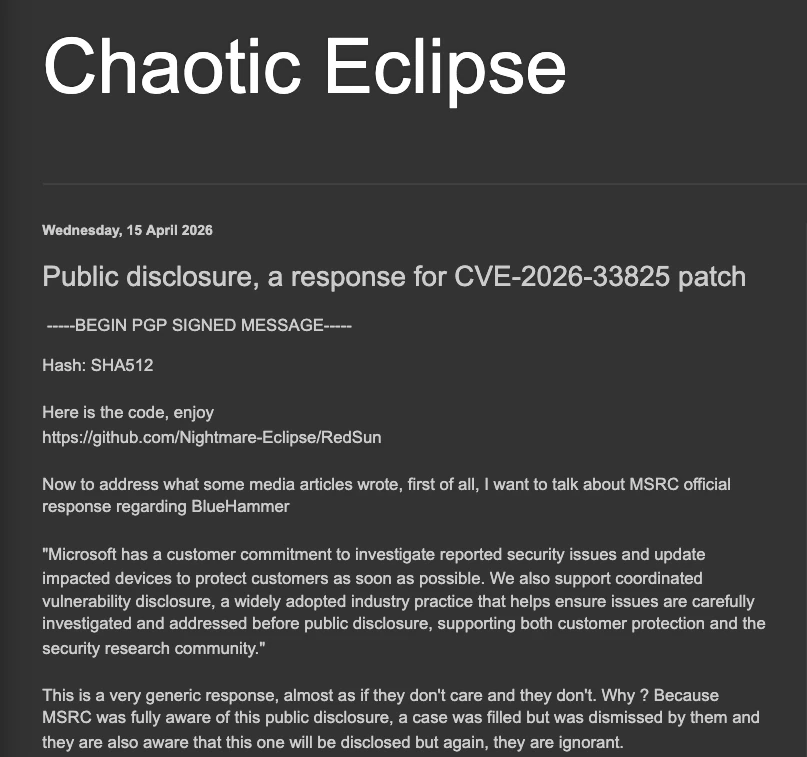
The tone of these statements suggests that the disclosures are not solely motivated by research transparency. The individual has indicated a willingness to release more severe vulnerabilities in the future, including potential remote code execution exploits, framing these actions as retaliation. Microsoft, for its part, has reiterated its standard position on coordinated vulnerability disclosure, stating that it investigates reported issues and works to protect users through timely updates. The company has not directly addressed the researcher’s allegations.
Broader Implications for Security
With exploit code now circulating publicly, the situation introduces immediate operational risks. Attackers who already have limited access to a system could potentially use such tools to escalate privileges and expand their control within a network. This type of access is often a critical step in lateral movement and deeper compromise. At the same time, the incident reflects a recurring tension in the cybersecurity landscape, where breakdowns in communication between researchers and vendors can lead to uncoordinated disclosures. These situations often blur the line between responsible research and adversarial behavior.
Conclusion
The release of a second Windows Defender exploit so soon after a patch underscores both technical and human factors in vulnerability disclosure. While the exploit itself raises questions about Defender’s internal handling of threats, the surrounding context highlights ongoing friction between independent researchers and large technology companies. As more details emerge, the balance between transparency, responsibility, and retaliation remains uncertain.




























No comments yet — be the first.
Join the conversation
Log in to leave a comment